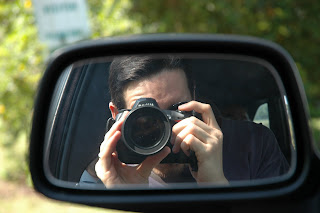
On Facebook at the moment, there's a meme going around, where you are supposed to write a note with 15 or 25 (depending who you ask) random things, facts, habits, or goals about yourself, and then tag some friends who you want to do the same. I thought my blog might also be an appropriate place to publish my reflections. So here goes:
1. Jesus first, my wife second, everything else third.
2. I believe that “We die only once, and then we are judged.” (Hebrews 9:27) If you die tonight, will you go to heaven? If you are not certain, talk to someone about it.
3. I believe the world was created in six days. I used to think otherwise, but in the mid-1990s I decided I was tired of just accepting what everyone else told me, so I did my own research. The evidence to my mind is overwhelmingly in favour of the universe having been created by an astoundingly clever designer.
4. I'm not the man I used to be, and that's a very good thing. God has done the most amazing miracles in my life. Not the “ta-da! magic” kind of miracles. He has changed my heart. I am actually amazed that some of my old friends who knew me as an arrogant, noisy schoolboy stuck with me long enough to see the changes. Thank you! (You know who you are.)
5. The older I get, the more comfortable I'm becoming with mystery. As a teenager I wanted to know and understand everything. The unknown was just a few books or semesters away. But now I have begun to recognize the unknowable. Some things I will simply never know, never understand. And I'm okay with that.
6. I was dux of my high school, got a TE score of 990, and was awarded an Australian Student Prize without even knowing such a thing existed. (The $2000 prize literally floored me when I got the letter about it. I sank to the floor in surprise.)
7. When I was a child, I wanted to be a teacher when I grew up. Both my parents had been maths teachers.
8. But I got side-tracked by my own intelligence—or perhaps more accurately, by my scholastic success. I got to the end of high school, and couldn't decide what to do at uni (uni was never optional for me), until one of my teachers showed me that I didn't have to choose between maths and computers, I could study both at the same time (in a Bachelor of Science course at UQ). At the end of my pass degree, the most natural thing to do was to continue on into honours. And the only honours course I qualified for was combined maths and computing.
9. At the time, and for a very long time afterwards, my honours year was the hardest work I'd ever done. Some of my maths subjects were so esoteric, my friend Scott and I would go to the refec after each fifty-minute lecture and spend a couple of hours talking it through, trying to get our heads around it.
10. My honours research project was in combinatorics. Specifically— actually, no, I won't bother trying to explain it. Ask me if you're interested.
11. My honours project was published in a journal (The Australasian Journal of Combinatorics, vol.14, p.109), and I was sent to a conference in Geelong to present it.
12. I nearly went broke while I was there. (My bank account got down to about $4.)
13. During my honours year I lived in a house in St Lucia with (variously) 4-6 other uni students. Only two were on the lease, which meant inspections were… interesting. Don't ask about meals, shopping, cleaning rosters or the TV. Or the car seat we used as a couch. Or the mangoes that fell into the pool. Come the think of it, I could probably write 25 random things just about share-house living in Brisbane—but I don't have to, because John Birmingham already did.
14. I got first class honours, with a GPA over the four years of around 6.5 (two 5s were my lowest results: in statistics and ODEs). I was awarded a university medal.
15. I nearly did a PhD. I applied for, and was granted, an APA scholarship for computational combinatorics.
16. But I took a job as a programmer instead, because it paid more.
17. I'm one of a relatively small number of people in the world who actually understand C++. Even pointers and memory management. Yes, even template instantiation.
18. I can still remember the opcodes for programming in 6502 machine code. I also speak Z80 and 68000. I like the 68000 the best. I was delighted when I discovered recently that my graphics calculator, a TI-84+, is driven by a Z80!
19. I nearly wrote my own operating system, twice. First time in high school, for an Apple ][e. Second time at uni, for a PC. Both times I decided in the end that the extant offerings would do, even if they weren't perfect.
20. I don't think computer programming should be called software engineering. Engineering as a discipline has been around for, what, maybe a thousand years? Computers have been around for less than a century. When we understand what we're doing a little better, and can reliably build software that does what we want, without failures requiring a restart, without annoying glitches, without blowing out the budget before we even get started… then perhaps we might be able to consider associating software with the dignified profession of engineering.
21. I stopped being a professional programmer in 2004. One morning I prayed that God would take away from me anything that stopped me from doing his will. By lunch time I had lost my job.
22. I started studying to be a teacher at QUT, but hated it.
23. I have lived in four countries and visited many more. I haven't been to South America or Antarctica. I speak two languages fluently and smatterings of a couple of others. I like languages and I'm fascinated by cultural differences.
24. But at the end of the day I like four countries the best. Scotland is very pretty (when it's not drizzling) and the people are nice. Germany appeals to my logical and organised side. Ireland stands for peace on the international scene. But Australia is where I consider my home to be.
25. Learning to play the violin and viola is quite possibly the hardest thing I've ever had to do. (Come on, I could hardly get to the end of this list of 25 things without mentioning music, now could I?) It's much harder than driving a car. I used to think I had poor motor skills and coordination, until I thought more carefully about just what exactly is involved in playing fiddle. But playing viola in chamber groups, right in the middle of the harmony and the sound… that's where I like to be.
Friday, February 6, 2009


Saturday, January 24, 2009
Yehudi Menuhin
I started reading Yehudi Menuhin's autobiography Unfinished Journey several years ago. Actually, I first found it in a library in Manchester in June 2003! I spent an hour or so browsing it there. But Manchester was a depressing place—it drizzled constantly, and there were basically no trees. So within days we had decided to hire a car and find someplace else to live.
But a few months later I found a second hand copy for sale for £2.50, and grabbed it. Yet I didn't get around to reading it until we'd been back in Australia for some time.
Two years ago, here's the brief review I wrote of what I'd read so far:
Fortunately, he did talk more about violin playing, and music in general, in the latter part of the book. Technique-wise he puts great emphasis on flexibility. He gets a little carried away when he compares the violin to the piano! (“Who could lavish affection on a piano? Or cuddle it, or carry it in his arms, or put it to bed in silk and velvet?”) He also discusses the school he set up in England. He even mentions Suzuki, by whose method I first learnt to play the violin.
His cultural commentary makes very interesting reading. As a travelling performer he has been to many, many different countries around the world, in peace-time and in war. He makes remarkable cultural comparisons based on his experience, for instance in regard to individual performers vs team and chamber players, and the corresponding differences in sight-reading ability.
I especially enjoyed Yehudi Menuhin's stories about his music because in some ways my own musical journey has been quite similar. I also began with violin (though not as early), and later added viola. I also am careful with my diet and (as I get older) with stretching before I play. And I also was an ugly violinist who married a beautiful wife!
The prose is easy to read, although being topically- rather than temporally-organised the story jumps around a little in place and time. My edition includes an index, of mostly names of people and places.
Recommendation: Worth reading if you like biographies or music, especially if you play strings—but beware if your favourite instrument is the piano!
But a few months later I found a second hand copy for sale for £2.50, and grabbed it. Yet I didn't get around to reading it until we'd been back in Australia for some time.
Two years ago, here's the brief review I wrote of what I'd read so far:
In accordance with the book's title, I have only got half-way through this book, and now it must be packed for our move to Mackay. Sigh. Worth reading, although I'm skipping quickly through some of it that I don't find interesting. I'd rather know more about his attitude to the violin (but he says he talks more about that in the latter half, which I haven't got to). I share his opinions of San Francisco (positive) and New York (negative).
Fortunately, he did talk more about violin playing, and music in general, in the latter part of the book. Technique-wise he puts great emphasis on flexibility. He gets a little carried away when he compares the violin to the piano! (“Who could lavish affection on a piano? Or cuddle it, or carry it in his arms, or put it to bed in silk and velvet?”) He also discusses the school he set up in England. He even mentions Suzuki, by whose method I first learnt to play the violin.
His cultural commentary makes very interesting reading. As a travelling performer he has been to many, many different countries around the world, in peace-time and in war. He makes remarkable cultural comparisons based on his experience, for instance in regard to individual performers vs team and chamber players, and the corresponding differences in sight-reading ability.
I especially enjoyed Yehudi Menuhin's stories about his music because in some ways my own musical journey has been quite similar. I also began with violin (though not as early), and later added viola. I also am careful with my diet and (as I get older) with stretching before I play. And I also was an ugly violinist who married a beautiful wife!
The prose is easy to read, although being topically- rather than temporally-organised the story jumps around a little in place and time. My edition includes an index, of mostly names of people and places.
Recommendation: Worth reading if you like biographies or music, especially if you play strings—but beware if your favourite instrument is the piano!
Sunday, January 18, 2009
New Year's Resolutions
First, how am I going with last year's? Okay, I think. Viola practice didn't happen quite as often as I'd like, and there is nowhere in Mackay for me to do any rock climbing, but otherwise I think I made some progress.
Some personal goals for this year:
On a related note, as you may know, a long-time goal of mine has been to put on some weight. I'm pleased to report that my gym program (and carefully-planned diet) is working well, and I am now over 65kg! (That's more than ever before in my life!)
Some personal goals for this year:
- Continue working on my drum playing
- Waste less time (and spend it on worthwhile pursuits instead)
- Lift my level of prayer, care and giving for missionaries
On a related note, as you may know, a long-time goal of mine has been to put on some weight. I'm pleased to report that my gym program (and carefully-planned diet) is working well, and I am now over 65kg! (That's more than ever before in my life!)
Saturday, January 10, 2009
CMS Summer School '09
CMS Summer School on Mt Tamborine was, as usual, excellent! Mike Raiter led us in some very challenging bible studies through Luke 9–19. We enjoyed fellowship with many old friends and made some new ones. The weather was fabulous, cool and mostly fine—way more pleasant than last year's pouring rain. The music was wonderful: congregational singing led by a few very talented musos, with a good variety of song styles. It is always uplifting to sing praises to God in a 500-strong choir!
This time around, QCCC refused to cater for us. So instead we self-catered in the Prezzy Palace (that's Camp Tamborine officially) kitchen.
And this year, we restrained ourselves somewhat in the bookshop. We only bought half a dozen books (some to be gifts) and four CDs.
Oh, and also: The old Chocolate Kingdom shop on Long St at the Gallery Walk has been sold. It's now selling the same chocolates at double or triple the price! But it turns out the other shop is still there (thanks Rachel!) and still selling Queensland's most delicious chocolates at the same old prices. You'll find it in the little shopping centre at the top of Henri Robert Drive (the Nerang road).
Next year, same place, Friday 1st to Thursday 7th January. See you there!
This time around, QCCC refused to cater for us. So instead we self-catered in the Prezzy Palace (that's Camp Tamborine officially) kitchen.
And this year, we restrained ourselves somewhat in the bookshop. We only bought half a dozen books (some to be gifts) and four CDs.
Oh, and also: The old Chocolate Kingdom shop on Long St at the Gallery Walk has been sold. It's now selling the same chocolates at double or triple the price! But it turns out the other shop is still there (thanks Rachel!) and still selling Queensland's most delicious chocolates at the same old prices. You'll find it in the little shopping centre at the top of Henri Robert Drive (the Nerang road).
Next year, same place, Friday 1st to Thursday 7th January. See you there!
Friday, January 2, 2009
A red-headed Canadian girl
I finally did it. I finally got around to reading a book that certain friends have been encouraging me to read since … oh, high school if not before. Which was a long time ago. But I'm rambling now.
Anne of Green Gables is an L M Montgomery classic. Anne is an orphan with bright red hair and freckles. The story begins with her adoption by an older pair, a brother and sister living in a small homestead in a provincial village (for want of a better word) on Prince Edward Island. Of course, they were expecting to be adopting a boy, to help out on the farm…
Of course you, dear reader, have probably read the book before, so I won't waste any more time outlining the plot. (Besides, you can go read it yourself anyway.)
I actually think it am better off for having read Anne now, later in life. I would not have understood it to nearly the same depth when I was a teenager (being a boy, and a socially inept one at that). And I certainly would not have coped with the sheer level of detail in the descriptive passages—which Laetitia insisted I read and appreciate when I suggested I might just skim lightly over the first couple. Having now had some exposure to teenage girls as a mature observer, in my role as a high school teacher, I can better understand the stories and characters than I would have back then.
So: An enjoyable book. Definitely a must-read. I cried at the end.
Anne of Green Gables is an L M Montgomery classic. Anne is an orphan with bright red hair and freckles. The story begins with her adoption by an older pair, a brother and sister living in a small homestead in a provincial village (for want of a better word) on Prince Edward Island. Of course, they were expecting to be adopting a boy, to help out on the farm…
Of course you, dear reader, have probably read the book before, so I won't waste any more time outlining the plot. (Besides, you can go read it yourself anyway.)
I actually think it am better off for having read Anne now, later in life. I would not have understood it to nearly the same depth when I was a teenager (being a boy, and a socially inept one at that). And I certainly would not have coped with the sheer level of detail in the descriptive passages—which Laetitia insisted I read and appreciate when I suggested I might just skim lightly over the first couple. Having now had some exposure to teenage girls as a mature observer, in my role as a high school teacher, I can better understand the stories and characters than I would have back then.
So: An enjoyable book. Definitely a must-read. I cried at the end.
Sunday, December 28, 2008
The Brain That Changes Itself
My father-in-law showed me this book when we visited recently. Within a few minutes I had decided it looked interesting, and possibly also useful for me as a teacher. I suggested to Laetitia that she could buy it for me for Christmas.
She did.
And I've just finished reading it. It's fantastic! A big book (280pp text + 130pp end-matter), but easy to read, it's full of amazing, inspiring personal stories along with fascinating insights into how the human brain works. Complex scientific theories and discoveries are explained in a straightforward and lucid manner, making the implications clear while avoiding excessive use of difficult terminology or grammar. (In other words, the writing is better than mine in that last sentence!)
My father-in-law recommended it to me because, he said, it spoke directly to how he felt as a stroke survivor. Strokes and brain damage are a significant part of the book's subject matter. Other topics include the links between sense, perception and action, learning difficulties, bad habits and obsessions, pain, and of course a fair depth of neurological anatomy and physiology. I particularly enjoyed the chapter on imagination and the appendix about culture.
One chapter I did have to skim through quickly. The author, Norman Doidge, goes into more explicit detail about a few sexual perversions than I personally care for. Respectfully and without hype, but it's just not something I want to read.
The author does write from an evolutionary point of view (in spite of the magnificent evidence presented for the glorious design of the human brain and nervous system), but this generally does not affect the material presented in the main body of the text. The appendix on culture is based heavily on evolutionary ideas—yet I still found it a good read (note my comment above).
The insights I've gained just from a first reading of this book will, I am already sure, help me in my day job as a high school teacher. And I will now be able to speak with more certainty to help some of my students with their own learning—habits of mind, study, etc.
And of course, I now want to go get my CaT scan of my brain from 2001, to see whether I can detect anything unusual. For instance, apparently musicians have stronger links between hemispheres, and a strong spatial awareness correlates with a large hippocampus. Anyone know any radiographers or neurologists who can help me know what I'm looking at?
Recommendation: Read this book. (Just beware chapter 4 if, like me, you prefer to stay with G or PG.)
She did.
And I've just finished reading it. It's fantastic! A big book (280pp text + 130pp end-matter), but easy to read, it's full of amazing, inspiring personal stories along with fascinating insights into how the human brain works. Complex scientific theories and discoveries are explained in a straightforward and lucid manner, making the implications clear while avoiding excessive use of difficult terminology or grammar. (In other words, the writing is better than mine in that last sentence!)
My father-in-law recommended it to me because, he said, it spoke directly to how he felt as a stroke survivor. Strokes and brain damage are a significant part of the book's subject matter. Other topics include the links between sense, perception and action, learning difficulties, bad habits and obsessions, pain, and of course a fair depth of neurological anatomy and physiology. I particularly enjoyed the chapter on imagination and the appendix about culture.
One chapter I did have to skim through quickly. The author, Norman Doidge, goes into more explicit detail about a few sexual perversions than I personally care for. Respectfully and without hype, but it's just not something I want to read.
The author does write from an evolutionary point of view (in spite of the magnificent evidence presented for the glorious design of the human brain and nervous system), but this generally does not affect the material presented in the main body of the text. The appendix on culture is based heavily on evolutionary ideas—yet I still found it a good read (note my comment above).
The insights I've gained just from a first reading of this book will, I am already sure, help me in my day job as a high school teacher. And I will now be able to speak with more certainty to help some of my students with their own learning—habits of mind, study, etc.
And of course, I now want to go get my CaT scan of my brain from 2001, to see whether I can detect anything unusual. For instance, apparently musicians have stronger links between hemispheres, and a strong spatial awareness correlates with a large hippocampus. Anyone know any radiographers or neurologists who can help me know what I'm looking at?
Recommendation: Read this book. (Just beware chapter 4 if, like me, you prefer to stay with G or PG.)
Tuesday, December 23, 2008
Christmas Letter 2008
Our Christmas letter is (once again) written up as a blog. You can read it at your leisure at http://bailey-mortimer-2008.blogspot.com/.
Merry Christmas!
Merry Christmas!
Subscribe to:
Posts (Atom)